
gan chin lee

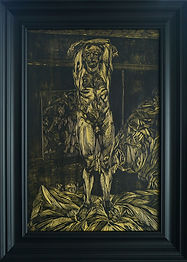
Installation view of Invasion and Resistance , 2025




意識的潮汐 融合的夢
tides of consciousness, fused dreams
I dreamt that my grandfather was still a child
His tiny hand in his mother’s callused palm
Following the silhouette of his father, her husband.
And him––a man in Republican-era suit
An old, wet map clutched in one hand, and a
Large suitcase in another
In the dark
Three of them
Trailed their steps from sea to shore
With wind, with salt, with shattering light,
And my shadow yet unborn.
Grandfather looked at the paper in his uncle’s hand,
At the old pine planted in the drawing.
Its roots breached the border of the map,
Creeping down to the sand beneath his feet––
And still they stretched,
Serpentining into the South China Sea.
My gaze traced that narrow course,
Unsteady, yet pressing forward,
Till it reached
The sea’s heart––where waves tossed and rolled,
And a boat, breathing with the tide,
Hung on the verge of storm.
The scene shifts––I am on the shore, and on the boat.
Ear against the wooden grain,
I listen as the waves reach the dark chamber of the tree’s rings.
The rust of colonial ships
Voices collide in tongues of many,
Blood and flesh flung into the raging sea.
On the same plane they scrape, clash, pile up,
Accreting into abstract soundscapes,
Waiting––
For the monsoons to intersect, to hurl their cries at me
Awakening my tangled sense of belonging,
Half a radical fantasy I choose,
Half a recoil I cannot control.
In my body the two forces meet,
Spiralling into a vortex––
From top to bottom, from without to within.
Screams, rending cries––
Helpless as Munch.
Then suddenly, the Nusantara-charmed wreck
Breaks water, rising with the surge.
Time halts.
Holding my breath, I feel the sweat
Tracing lines down my forehead,
A blade etching my yellow face,
Splitting sight in two.
Like a chameleon’s eyes, each probes on its own––
Uneasy, vigilant.
In this very moment, new images erupt:
Here, Turner’s impressionistic glow, yellow and violet entwined;
There, their imperial dream,
Born of a radical romanticism.
And yet
A working country is hardly ever a landscape
Those who came from empires to enlighten
Could never guide the knife-wielding hands in the rubber groves,
Could never show them how to trace the soil they saw,
How to shape the bonds they felt.
The chiaroscuro that revealed God’s radiance
Failed to light the face
Of Chinese New Villages
Breathing beneath banana breezes and coconut fronds.
Or was it Baroque drama after all?
Or the Cold War’s abstract law?
No. No. No.
The candle held piously in De La Tour’s child
Could never depict
The fire of my mother’s hearth in the New Village kitchen,
Nor the dawn light pressing through Rothko’s
Windows of suppressed spirit.
Yes––
Light, always light––
Once heralding truth,
But never the light I see each morning
Breaking through the window’s crack.
我曾夢見祖父還是個小孩
他那纖細的小手挽著母親長繭的掌心
一起跟著——他父親、她夫婿——的背影
而他 一個民國裝扮的男人
一手攥著一張潮濕的老地圖 一手拿著一口大皮箱子
暗夜裡
三個人
從海裏緩緩走上岸
有風 有鹹味 有碎裂的光
及我尚未出生的影子
祖父看著他阿叔手上那張紙 和種於圖上的那棵老松
樹根自紙上版圖邊線越界而出 一路蔓延至腳下的沙灘
還不止——
它仍蜿蜒,直入南中國海
我的視線沿著那細長軌跡
搖擺不定 卻仍前行
直到
海心處—— 浪濤翻卷
和跟著潮汐上下呼吸的 漂浮的船
頃刻就要被暴風雨吞噬
畫面在轉 我在岸上 也在船上
我把耳朵貼於船身木紋上
傾聽海浪抵達年輪的暗室
殖民船隻的鐵鏽
多語混響的廣播
投奔怒海的血肉
它們在同一塊板面上刮擦、交鋒、堆疊、刻勒成抽象的音軌
等待——
季風交錯的此刻 爭相對我哭訴
我那複雜的歸屬感 隨之激發
一種自主地激進幻想 與一種不由自主的反向抗力
兩股力量在體內交匯成漩渦——自上而下、由外而內
吶喊、撕扯——
如蒙克般無助
霎那間,努山達拉的咒語破船隨勢升起
時間停頓
屏息之際 額頭的汗珠
從點流成線,如刻刀劃過我黃色的臉
劃拉出兩邊視野
像變色龍的雙眼,左右獨立探察
多疑、敏感——
目下此刻 新的意象迭出
一邊是
透納那黃與紫互補交織而成的印象派光暈
另一邊是
他們激進浪漫主義下的帝國夢
可是
A working country is hardly ever a landscape
帝國來的啟蒙者 無法指導膠林裡拿刀的手
如何勾勒眼裡的風土 怎樣刻劃心裡的人情
他們那種描繪上帝之光的明暗對照法
無法照亮蕉風椰林之間的那些
華 - 人 - 新 - 村 – 肖 - 像
還是——巴洛克的戲劇張力?
抑或——冷戰的抽象法則?
不。不。不。
虔誠如拉圖尔畫中那孩童的手持燭光
描繪的豈是我母親新村廚房的灶火
更不會是馬克羅斯科壓抑心靈下的視窗曙光
是的——
都是光
也曾昭示真理
卻不是我每天眼睛張開後看到的
那道穿過窗口裂縫處的一束晨光

Invasion and Resistance: An Emancipatory Turn
by Azzad Diah Ahmad Zabadi
(This essay was published at Ilham Art Show 2025's catologue, Jan 2026 )
Gan Chin Lee's Invasion and Resistance represents a pivotal shift in his artistic exploration - a moment where material, history, and identity coalesce into a critique of Eurocentric artistic dominance. The nine carved wooden panels, gilded with gold lacquer, draw on Vietnamese lacquer practices and Chinese plaque-making traditions. Through this return to Asian craftsmanship, Gan reopens questions about lineage, be-longing, and the politics of artistic formation in a Malaysian context. The compositional centrepiece, a four-panel relief depicting figures struggling aboard a wooden boat amid ferocious waves, reveals the density of Gan's intellectual and visual references. The carved surface transforms the traditionally painterly into something resistant, tactile, and irrevocable. Unlike oil paint, which allows correction and concealment, carved wood refuses revision. Each incision becomes a mark of commitment. This materiality mirrors identity as layered, scarred, shaped by forces that cannot be simply painted over. Gan's references to art historical "mas-ters are intentionally unruly. Fragmented figures evoke Goya's tumultuous human conditions, Velázquez's spatial intelli-gence, Degas's psychological melancholy, Courbet's corporeality, Kollwitz's emotional intensity, and Liu Xiaodong's contemporary realism. Yet these Western images are destabilised through an Asian formal vocabulary - most notably in the wave forms rendered in the manner of Hokusai. Such intercultural visual entanglement reflects the complexity of Southeast Asian artistic heritage, where global and local narratives intersect, overlap, and contest one another. This entanglement is distinguishable through Gan's biography. Born in Jenjarom, aChinese-majority New Village in Selangor, Gan's artistic training took him from illustration studies in Malaysia to advanced mural painting and an MAin Fine Art at the Central Academy of Fine Art (CAFA) in Beijing. Although geographically distant from the Euro-American art centres, both Malaysia and China's art academies continue to uphold Western-derived principles, Gan's mid-career reflection therefore confronts a fundamental question: How does one articulate a Southeast Asian artistic identity while shaped by pedagogical structures that privilege Western art history? An archival photograph of painter Low Kwang Soo helped activate these reflec-tions. In the image, Low stands in Western clothing in a traditional wooden kampung studio, while surrounded by oil paintings. The juxtaposition between Western me-dium, modern attire, and the vernacular studio environment encapsulates what Philipp Stockhammer describes as "cultural entanglement"— a process where cultures shape each other reciprocally rather than hierarchically. Gan reads the photograph not as evidence of assimilation but of nego-tiation, tension, and hybridity - a condition foundational to Malaysian modern art. Wood, as Gan's chosen material, functions as both inheritance and critique. Chinese ancestral plaques, surname boards, and tanghao (hall names) historically articulated familial belonging through place-based identifiers, often tied to regions in China.2 In diasporic contexts like Malaysia, these objects became anchors of memory, mapping migratory histories and sustaining a sense of community beyond nation-state boundaries. This genealogy intersects with the political history of Jenjarom itself. Established as part of the British Briggs Plan in the early 1950s, the New Villages were designed to surveil and control Chinese rural populations during the Malayan Emergency. The village structure, there-fore, was never neutral - it was born from colonial spatial engineering. Gan's decision to house Invasion and Resistance within a reconstructed wooden dwelling invokes this layered history. The house bereft itself a nostalgic motif but a spatial critique: a reminder of structural containment, cultural resilience, and the formation of diasporic subjectivity under coercive conditions. Gan's technique of carving Western masterpieces into wood extends this critique into the realm of material decolo-nisation. Rather than reproducing Goya's or Courbet's compositions, he shifts their meaning by re-mediating them through woodcut- a method historically aligned with mass education, resistance, and political awakening. This echoes Lu Xun's advocacy for the woodcut movement in early 20th-century China, where he saw the medium as a tool for social enlightenment and anti-oppression." By activating this lineage, Gan transposes Western canonical images into a framework of Asian political and material agency. By this logic, Invasion and Resistance is a self-portrait - not through resemblance but through methodology. The boat tossed on waves symbolises the artist navigating competing histories. The figures, drawn from both Western and Eastern imagery, embody hybridised subjectivities. The waves, rendered in Hokusai's style, symbolise the cultural currents that buffet and shape the artist's position. Carving becomes both resistance and affirmation: a refusal to accept inherited narratives without question. The nine panels, installed within a reconstructed wooden house, articulate identity through material, memory, and place. The house grounds the viewer in the vernacular world of Gan's upbringing - a world shaped by diaspora, colonial planning, and community resilience. The wooden structures echo the carved panels, reinforcing the idea that identity, like wood, retains every mark pressed into its surface. Ultimately, Invasion and Resistance embodies a decolonial sensibility that neither rejects Western art nor romanticises Asian tradition. Instead, Gan proposes a third space - a carved space - where negotiation, hybridity, and reinterpretation become tools of emancipation. His work invites viewers to consider how identity is formed through the interplay of influence and resistance, inheritance and invention. Through this material and conceptual labour, Gan asserts an artistic agency grounded in place, sharpened by history, and carved with deliberate persistence. 1. Philipp W. Stockhammer, ed., Conceptualizing Cultural Hybridization: A Transdisciplinary Approach (Berlin: Springer, 2012), 1-18 2. Wolfram Eberhard, A Dictionary of Chinese Symbols: Hidden Symbols in Chinese Life and Thought (London: Routledge & Kegan Paul, 1962), 284. 3. T.N. Harper, The End of Empire and the Making of Malaya (Cambridge: Cambridae University Press, 19991,199 4. Julia F. Andrews, Painters and Politics in the People's Republic of China, 1949-1979 (Berkeley: University of California Press, 1994), 27-45